
Not all real estate offers are created equal.
Understanding Real Estate Contingencies
A real estate contingency is a condition that must be satisfied before a transaction can move forward as planned. While price often receives the most attention, contingencies help explain why two offers with the same price may lead to very different outcomes.
For many sellers, the challenge is not receiving offers — it is understanding what those offers actually mean in practice.
What Is a Real Estate Contingency?
A contingency is a contractual condition included in a real estate offer or purchase agreement.
It must be satisfied, waived, or resolved before the transaction can proceed to closing.
In simple terms, a contingency works like an “if this, then that” condition that defines how the deal moves forward.
For example: if financing is approved, the transaction continues. If not, the agreement may pause, renegotiate, or terminate depending on the contract.
Contingencies are a standard part of real estate transactions. They are not inherently good or bad — they simply define how risk and uncertainty are managed between buyer and seller.
Why Do Contingencies Exist?
Contingencies exist to manage uncertainty in a transaction where not everything can be confirmed upfront.
These conditions help structure how unknowns are handled before closing.
For buyers, contingencies provide protection and time for due diligence.
For sellers, contingencies become especially important when comparing multiple offers, since they can affect certainty, timing, and the likelihood of closing.
Common areas of uncertainty include:
- Financing approval
- Property condition
- Property valuation
- Legal ownership (title)
- Insurance eligibility
Common Types of Real Estate Contingencies
Not every contingency has the same impact on a transaction. Some mainly protect the buyer, while others can significantly affect timing, certainty, or negotiation dynamics.
Financing Contingency
Allows the buyer time to secure mortgage approval. If financing cannot be obtained under agreed terms, the offer may not proceed.
Inspection Contingency
Gives the buyer the right to review the property’s condition and request repairs or renegotiate based on findings.
Appraisal Contingency
Protects against situations where the appraised value is lower than the purchase price, which can affect lender approval.
Sale-of-Home Contingency
Makes the purchase dependent on the buyer successfully selling their current home.
Title Contingency
Ensures the property’s ownership is clear and free of unresolved legal claims or liens.
Insurance Contingency
Confirms that acceptable insurance coverage can be obtained for the property.
How Contingencies Affect Sellers
For sellers, contingencies influence how predictable an offer is — not just how high the price is.
When reviewing offers, sellers often evaluate:
- Likelihood of closing
- Potential delays in the timeline
- Risk of renegotiation after inspections or appraisals
- Buyer financial strength and qualification level
- Overall certainty of completion
A contingency is not necessarily a problem, but it may affect how predictable the transaction will be.
This becomes especially important when comparing multiple offers side by side, where small structural differences can lead to very different outcomes.
Comparing Offers Beyond Price
One of the most common misconceptions in real estate is that the highest price automatically represents the strongest offer.
Purchase price
The offered price for the property
Contingency structure
The conditions and obligations in the offer.
Financing method
Cash loan or alternative financing options.
Closing timeline
The expected time to close
Buyer qualifications
Experience financial strength and ability to perform
Overall transaction certainty
The likelihood of a smooth and successfull closing.
Are Fewer Contingencies Always Better?
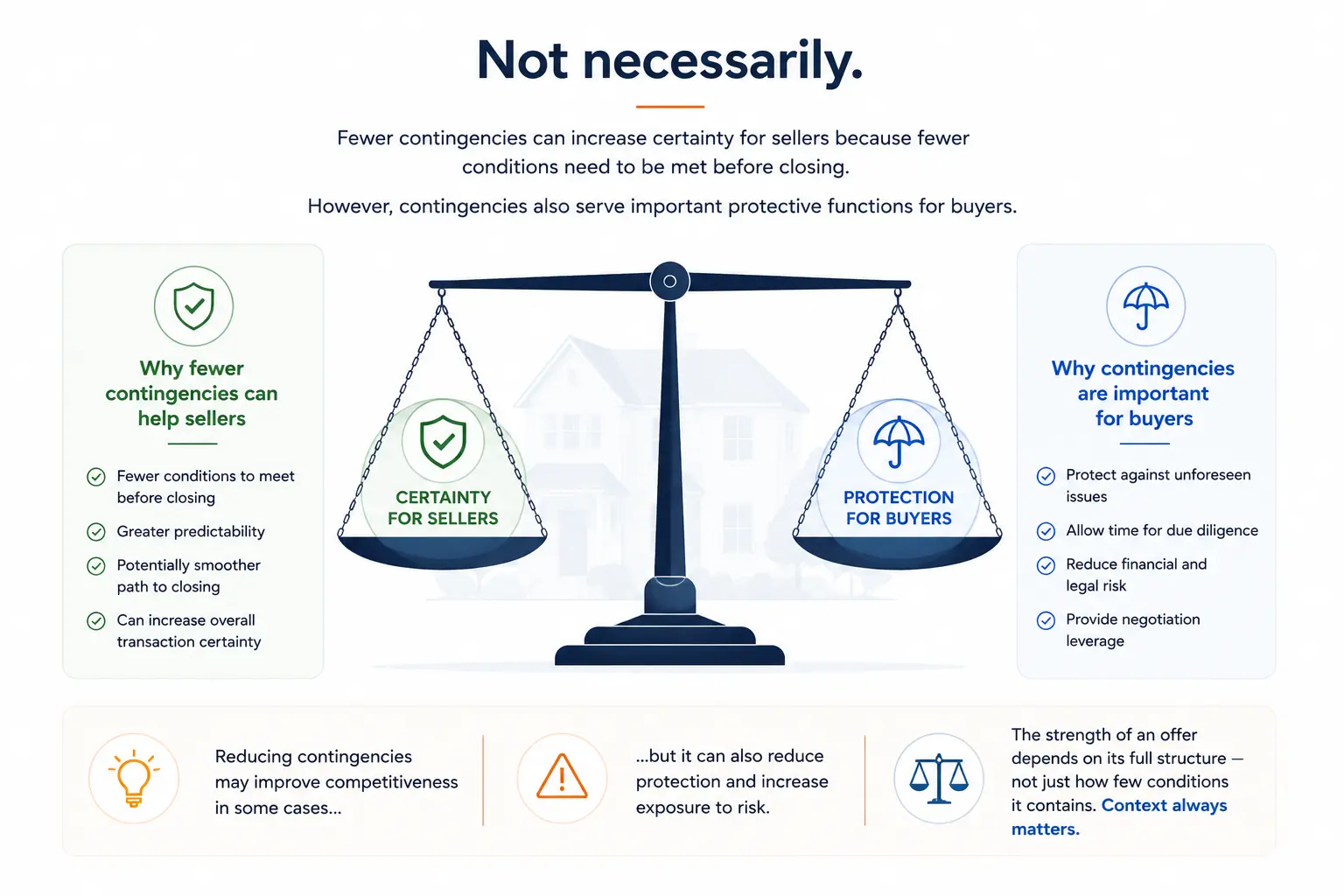
Not necessarily.
Fewer contingencies can increase certainty for sellers because fewer conditions need to be met before closing.
However, contingencies also serve important protective functions for buyers.
Reducing contingencies may improve competitiveness in some cases, but it can also reduce protection and increase exposure to risk.
The strength of an offer depends on its full structure — not just how few conditions it contains.
Context always matters.
Key Questions to Ask When Reviewing Contingencies
When evaluating or comparing offers, it can help to ask the right questions help move evalution beyond surface-level price comparison.
- What conditions must be satisfied before closing?
- How long does each contingency last?
- Which contingency is most likely to affect closing?
- Has the buyer demonstrated the ability to meet key conditions?
- What events could delay or change the transaction timeline?
- What rights does each party retain during the contingency period?
- How does this offer compare to others when viewed side by side?
Understanding the Role of Contingencies
Contingencies shape how a real estate transaction moves from offer to closing.
📄
1. Offer
The buyer submits their terms.
🛡️
2. Contingencies
Conditions are defined by both parties.
🔍
3. Review
Terms, risks, and requirements are evaluated.
👥
4. Decision
The best overall opportunity is selected.
🏠
5. Closing
Conditions are met and the deal moves forward.
Compare Offers Beyond Price
Understand how contingencies, financing, timing, and buyer strength work together when evaluating multiple offers side by side.
Learn How Offer Review Works
Explore how structured offer comparison helps bring clarity to different types of real estate offers.
FAQs
What is a real estate contingency?
A real estate contingency is a condition in a purchase agreement that must be satisfied, waived, or resolved before the transaction can proceed.
Are contingencies common in real estate transactions?
Yes. Most transactions include one or more contingencies related to financing, inspections, appraisal, title, or insurance.
Can a seller accept an offer with contingencies?
Yes. Many sellers accept contingent offers. The decision depends on price, terms, timing, and overall certainty of closing.
Do cash offers have contingencies?
Sometimes. Cash offers often remove financing contingencies, but may still include inspection, title, or insurance contingencies.
Can a transaction fail because of a contingency?
Yes. If a contingency is not satisfied or waived, the transaction may be delayed, renegotiated, or terminated depending on the agreement.
Are fewer contingencies always better?
Not always. Fewer contingencies can increase certainty but may reduce buyer protection. The best offer depends on the full combination of price, terms, and conditions.